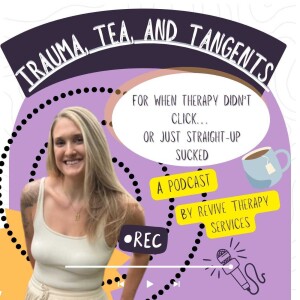
Trauma, Tea, and Tangents
For when therapy didn’t click...or just straight-up sucked. Trauma, Tea, & Tangents is your weekly dose of unfiltered, unapologetic, and unexpectedly healing conversation. Hosted by Hannah Guy, LCSW—a trauma therapist who knows firsthand that healing isn’t linear, self-growth is messy, and sometimes you just need to laugh at the chaos—this podcast dives into all things trauma, nervous system, and the wild ride of being human. Expect a blend of real talk, solid science, and compassionate hot takes, sprinkled with plenty of tangents (because who actually stays on track when they’re talking about trauma?). So grab your tea, get comfy, and let’s spill, sip, and sort through it all—one tangent at a time.
Listen on:








Episodes
7 days ago
7 days ago
What does healing your relationship with your body actually look like after an eating disorder?
In this episode of Trauma, Tea, and Tangents, we sit down with Hannah Guy and Katelyn Campbell, Psy.D., who specializes in working with eating disorders, to explore the complex and non-linear journey of body image healing and recovery. From deep-rooted body hatred to developing body neutrality, this conversation breaks down what it really takes to move toward acceptance—without toxic positivity.
We talk about the societal pressures that shape negative body image, the role of cognitive rigidity in keeping people stuck, and how developing cognitive flexibility can support long-term healing. This episode is a powerful reminder that recovery isn’t one-size-fits-all—and that “fully recovered” can look different for everyone.
Whether you’re navigating your own healing journey or supporting someone who is, this conversation offers insight, validation, and a more compassionate perspective on body image and eating disorder recovery.
In this episode, we cover:
Body image struggles after eating disorder recovery
The roots of body hatred and internalized beliefs
Moving from body hatred to body neutrality
Cognitive rigidity vs. cognitive flexibility in treatment
Redefining recovery and what “healed” really means
Finding identity and purpose beyond your body
Chapters:00:00 Introduction to Body Image and Eating Disorders05:43 Understanding the Roots of Body Hatred11:30 Moving Towards Body Neutrality16:41 Cognitive Rigidity and Flexibility in Treatment22:59 Finding Purpose Beyond Body Image
✨ Want more of Katelyn Campbell?
Find her here:
Website: katelyncampbellpsyd.com
TikTok: @growing.a.therapist
Instagram: dr.katelyncampbell
✨ Want to work with Hannah and the trauma therapy team at Revive Therapy Services?You’ve gotta be a PA resident—check us out at revivetherapyservices.comAnd don’t forget to follow along on TikTok & IG: @revivetherapyservices
Friday Mar 20, 2026
Friday Mar 20, 2026
What does it really mean to be authentic in therapy—and why does it matter so much for healing?
In this episode, Hannah Guy sits down with therapist Kamber Peerboom, LICSW, to explore how authenticity shapes the therapist-client relationship in ways that go far beyond traditional clinical training. They unpack the pressure therapists often feel to present as “perfect” or neutral, and how that can actually create distance instead of connection.
Together, they dive into the powerful concepts of rupture and repair, why those moments are not failures in therapy, and how they can deepen trust when handled with care. They also explore how social media is influencing the way therapists show up—and what that means for client expectations, boundaries, and finding the right therapeutic fit.
Whether you’re in therapy, considering starting, or a therapist yourself, this conversation offers an honest, nuanced look at what real connection and progress actually look like.
In this episode, we cover:
What authenticity in therapy actually looks like
How therapist training can sometimes discourage genuine connection
The role of rupture and repair in building trust
How social media is shaping therapist identity and client expectations
Why finding the right therapist fit matters more than you think
The subtle, often overlooked signs of progress in therapy
Chapters: 00:00 Introduction to Authenticity in Therapy05:56 Rupture and Repair in Therapy11:00 The Importance of Authentic Connections17:05 Social Media's Role in Therapy23:25 The Subtlety of Progress in Therapy
✨ Want more of Kamber Peerboom?
Find her here:
Linktree: https://linktr.ee/therapistkamber?utm_source=ig&utm_medium=social&utm_content=link_in_bio&fbclid=PAZXh0bgNhZW0CMTEAc3J0YwZhcHBfaWQMMjU2MjgxMDQwNTU4AAGnOd3oa7iVk-1EK0-iZRnurOLAuoaZgt_7cgrHsEKl5QYJePxA8cXmtfm8LSg_aem_FeadHYgbRm0mgVEvM3haYAInstagram: @meanoldersistertherapist
✨ Want to work with Hannah and the trauma therapy team at Revive Therapy Services?You’ve gotta be a PA resident—check us out at revivetherapyservices.comAnd don’t forget to follow along on TikTok & IG: @revivetherapyservices
Friday Mar 13, 2026
Friday Mar 13, 2026
What if the way you eat could directly impact your mental health, mood, and stress levels?
In this episode, Hannah Guy sits down with registered dietitian Melissa Wadolowski to explore the powerful connection between nutrition and mental health. They break down the science of the gut-brain connection, explain how the gut microbiome influences mood and brain health, and share practical strategies for supporting mental wellness through balanced nutrition.
Learn why food shouldn’t be about restriction, how intuitive eating can help you rebuild a healthier relationship with food, and why sustainable, mindful eating habits are essential for long-term well-being. They also discuss the role of nutrients like magnesium for anxiety, omega-3 fatty acids, and fiber in stress regulation, hormone balance, sleep quality, and emotional wellness.
If you’ve ever wondered how your diet, gut health, and eating habits can influence your mood, energy, or trauma recovery, this episode provides a compassionate and realistic approach to holistic mental health through nutrition.
Episode Chapters:00:00 Introduction to Nutrition and Mental Health03:55 Understanding the Gut Microbiome06:26 Nutrition's Role in Mental Health09:11 Practical Nutrition for Mental Well-being12:01 The Importance of Sustainable Eating Habits14:44 Addressing Food Morality and Enjoyment17:42 Mindfulness in Eating20:26 Nutrition and Trauma Recovery23:12 The Role of Fiber and Omega-3s25:51 Fasting and Its Benefits28:39 Conclusion and Resources
✨ Want more of Melissa Wadolowski?
Find her here:
https://prolifestylenutrition.com/melissa-wadolowski/
https://prolifestylenutritionllc.practicebetter.io/#/67eb55881d0cb7c0a5eb5919/bookings?s=619d8a803980330c8461d5de&step=date
✨ Want to work with Hannah and the trauma therapy team at Revive Therapy Services?You’ve gotta be a PA resident—check us out at revivetherapyservices.comAnd don’t forget to follow along on TikTok & IG: @revivetherapyservices
Friday Mar 06, 2026
Friday Mar 06, 2026
What is hyper-independence in relationships — and why does it make vulnerability feel so uncomfortable?
In this episode of Trauma, Tea, and Tangents, Hannah Guy is joined by guest Kelsey Wood, marriage and family therapist and coach, to explore how hyper-independence affects romantic relationships, dating patterns, emotional health, and long-term partnership dynamics.
If you’ve ever wondered:
Why do I struggle to be vulnerable in relationships?
Why do I feel like I can’t rely on my partner?
Why do I try to control outcomes in dating?
Why do I have such rigid expectations in romantic partnerships?
This conversation breaks down how hyper-independence develops, how it shows up in dating and romantic relationships, and why building inner self-trust is essential for healthy emotional intimacy.
Hyper-independence often creates a deep need for control, reinforces scarcity mindset in dating, and strengthens rigid expectations that block authentic connection. True intimacy requires releasing control, shifting beliefs about vulnerability, and learning to trust yourself from the inside out.
Chapters:
00:00 – Understanding Hyper-independence in Relationships07:00 – The Struggle for Vulnerability11:38 – Navigating Control and Trust15:10 – Dating Rules and Expectations20:22 – The Impact of Mindset on Relationships
✨ Want more of Kelsey Wood?Find her here:https://www.kelseywoodtherapyandcoaching.com/Instagram: @teatimetherapistSubstack: https://substack.com/@teatimetherapist
✨ Want to work with Hannah and the trauma therapy team at Revive Therapy Services?You’ve gotta be a PA resident—check us out at revivetherapyservices.comAnd don’t forget to follow along on TikTok & IG: @revivetherapyservices
Friday Feb 27, 2026
Friday Feb 27, 2026
Hyper independence is often a trauma response rooted in childhood trauma and unmet emotional needs. In this episode, Hannah Guy sits down with therapist and coach Kelsey Wood to explore how high-functioning women develop self-reliance as a survival strategy — and why control can feel safer than vulnerability.
Together, they unpack how childhood experiences shape attachment styles, emotional regulation, and adult relationships. They discuss feminine energy, intergenerational trauma, over-functioning, anxiety, and the hidden exhaustion that comes from always being “the strong one.” If you struggle with asking for help, fear vulnerability, or feel safer doing everything alone, this conversation will resonate deeply.
This episode is for women navigating therapy, mental health, healing, and personal growth. You’ll learn how hyper independence can shift from trauma response to intentional strength — and why learning to receive support is essential for secure attachment and emotional healing.
Chapters
00:00 – Introduction to Hyper Independence and Trauma02:43 – Understanding Hyper Independence as a Trauma Response05:32 – The Impact of Childhood Experiences on Adult Relationships08:27 – Navigating Emotional Needs and Trauma11:18 – The Balance of Masculine and Feminine Energy13:56 – Recognizing the Need for Control16:53 – The Turning Point: When Hyper Independence Becomes a Burden19:37 – Reconciling Parental Relationships and Childhood Trauma22:30 – Intergenerational Trauma and Its Effects25:24 – Using Hyper Independence as a Strength27:57 – Conclusion: Embracing Vulnerability
✨ Want more of Kelsey Wood?Find her here:https://www.kelseywoodtherapyandcoaching.com/Instagram: @teatimetherapistSubstack: https://substack.com/@teatimetherapist
✨ Want to work with Hannah and the trauma therapy team at Revive Therapy Services?You’ve gotta be a PA resident—check us out at revivetherapyservices.comAnd don’t forget to follow along on TikTok & IG: @revivetherapyservices
Friday Feb 20, 2026
Friday Feb 20, 2026
In this episode of Trauma Tea and Tangents, Sex Therapist Esme Vallette returns to explore one of the most powerful — and misunderstood — aspects of trauma recovery: healing within relationships.
Can a relationship actually help you heal trauma? What happens when your safest partner becomes your biggest trigger? And how do you balance personal responsibility with healthy support?
We dive deep into emotional safety, attachment wounds, codependency, relationship triggers, and the role of individual therapy in trauma healing. Esme breaks down how partners can support each other without becoming each other’s therapist — and why discomfort in a relationship doesn’t automatically mean you’re unsafe.
This conversation is essential listening for anyone navigating trauma recovery while in a relationship — or hoping to build one that supports growth instead of repeating old patterns.
If you’ve ever wondered:
“Why do I get triggered in safe relationships?”
“Is my partner responsible for my healing?”
“What’s the difference between support and codependency?”
“Can love actually help trauma heal?”
This episode gives you grounded, therapist-backed clarity.
Relationships can be healing — but they shouldn’t be the only place you heal.
⏱ Chapters
00:00 – Introduction to Healing in Relationships01:09 – The Role of Partners in Healing04:53 – Understanding Triggers and Trauma Responses08:45 – Responsibility in Relationships12:17 – Codependency vs. Healthy Support15:06 – Finding Safe Relationships19:26 – What Does “Safety” Really Mean?23:33 – Why Individual Therapy Matters25:39 – Final Thoughts & Closing Reflections
Joining us for this raw and real convo is Esme Valette, licensed sex therapist and fierce advocate for trauma-informed sex education. Esme opens up about her experience working with survivors, the practical tactics she uses with clients, and how to reclaim intimacy at your own pace. Expect wisdom, vulnerability, and a few healing tangents along the way.
✨ Want more of Esme? Follow her on IG & TikTok: @therapy_with_esme
✨ Want to work with Hannah and the trauma therapy team at Revive Therapy Services?
You’ve gotta be a PA resident—check us out at revivetherapyservices.com
And don’t forget to follow along on TikTok & IG: @revivetherapyservices
Friday Feb 06, 2026
Friday Feb 06, 2026
Why does pleasure feel unsafe after trauma?
Hannah Guy and sex therapist Esme Valette explore how trauma, conditioning, and performance-based intimacy disconnect us from pleasure—and how slowing down, curiosity, and non-goal oriented touch can help rebuild safety, connection, and trust with the body.
Takeaways:
How cultural and religious backgrounds shape perceptions of pleasure
Why sex is often taught as a linear, goal-oriented experience
How non-goal oriented touch can reduce pressure in intimacy
The importance of slowing down in trauma healing
Using curiosity about sensation to support healing
Communicating boundaries, needs, and desires with partners
Why changing your mind about intimacy is always valid
Expanding intimacy beyond penetration
The role of self-exploration in understanding pleasure
Chapters
00:00 Rebuilding Pleasure: A Journey of Healing08:52 Non-Goal Oriented Touch: Redefining Intimacy18:12 The Power of Curiosity in Healing26:30 Communicating Needs: Slowing Down for Connection
Joining us for this raw and real convo is Esme Valette, licensed sex therapist and fierce advocate for trauma-informed sex education. Esme opens up about her experience working with survivors, the practical tactics she uses with clients, and how to reclaim intimacy at your own pace. Expect wisdom, vulnerability, and a few healing tangents along the way.
✨ Want more of Esme? Follow her on IG & TikTok: @therapy_with_esme
✨ Want to work with Hannah and the trauma therapy team at Revive Therapy Services?
You’ve gotta be a PA resident—check us out at revivetherapyservices.com
And don’t forget to follow along on TikTok & IG: @revivetherapyservices
Friday Jan 16, 2026
Friday Jan 16, 2026
What if feeling “broken” after trauma isn’t a sign that something’s wrong with you — but actually proof your nervous system did what it needed to survive?
In this episode, therapist Hannah Guy gets real about the messy, confusing feelings that often come after trauma and how they show up in our relationships. Why can love, intimacy, and even close friendships feel triggering? How do we navigate grief, self-doubt, and moments of dysregulation without beating ourselves up?
Hannah shares personal insights and professional guidance, reframing the idea of being “broken” and showing what real healing looks like — it’s not about being perfect or “fixed,” it’s about slowly learning to feel safe in your body, with yourself, and with others. If you’ve ever felt stuck, judged your own feelings, or wondered why relationships feel harder than they “should,” this episode is for you.
Chapters
00:00 — Introduction to Trauma & Personal Experience03:03 — Understanding the Feeling of Being “Broken”07:33 — How Trauma Impacts Relationships13:58 — Navigating Love & Intimacy After Trauma17:54 — Healing: What It Really Looks Like20:59 — Reframing the Belief of Being Broken
✨ Want to work with Hannah and the trauma therapy team at Revive Therapy Services?
You’ve gotta be a PA resident—check us out at revivetherapyservices.com
And don’t forget to follow along on TikTok & IG: @revivetherapyservices
Friday Dec 12, 2025
Friday Dec 12, 2025
In this episode, therapist Hannah Guy breaks down why decision-making feels overwhelming for people with trauma histories and chronic anxiety. She explains how the nervous system confuses emotional discomfort with danger, why trauma creates pressure to make the “right” choice, and how fight/flight/fawn/freeze show up when we’re faced with everyday decisions.
Hannah shares trauma-informed tools to reduce decision paralysis, regulate the body, and approach choices with more clarity and less fear. You’ll learn grounding practices, reflective questions, and a new perspective on uncertainty: decisions are experiments, not life sentences.
Topics covered include trauma responses, attachment triggers, emotional regulation, nervous system healing, somatic strategies, and reframing high-stakes thinking in dating, relationships, and major life transitions.
If you struggle with overthinking or fear of making the wrong choice, this episode offers practical support and a gentle mindset shift.
✨ Want to work with Hannah and the trauma therapy team at Revive Therapy Services?
You’ve gotta be a PA resident—check us out at revivetherapyservices.com
And don’t forget to follow along on TikTok & IG: @revivetherapyservices
⏱️ Episode Chapters
00:03 — Welcome + Why This Topic Matters Intro to the episode, why “the right decision” comes up so often in therapy and real life.
00:49 — The Pressure to Choose Correctly How perfectionism and fear show up in everyday decision-making.
01:21 — A Personal Look at Decision Anxiety Hannah shares how dating activates her own decision spirals.
03:21 — Trauma Makes Choices Feel Like Survival Why your brain treats emotional danger like physical danger.
04:48 — How Trauma Turns Normal Decisions Into Threats Coffee dates, texts, jobs—why everything feels high stakes.
06:42 — Fight/Flight/Fawn/Freeze in Decision-Making How each trauma response shows up when you’re faced with choices.
09:04 — The Myth of the “Right” Decision Why one perfect path doesn’t exist and how trauma convinces us otherwise.
11:15 — The Fantasy of Certainty How our nervous system chases the illusion of safety through “right choices.”
12:52 — Decisions Are Experiments, Not Life Sentences Reframing choices as learning instead of permanent outcomes.
13:07 — Regulating Before You Choose Why your body—not logic—makes decisions feel impossible.
13:12 — Tools to Return to Regulation Grounding, orienting, breathwork, and naming the scared parts.
15:38 — What Clarity Actually Feels Like How clarity shows up once the nervous system calms down.
17:50 — Building Tolerance for Uncertainty Expanding your window of tolerance around big and small decisions.
18:29 — You’re Not Meant to Be Regulated All the Time Debunking the myth of constant calm.
19:07 — Mastery Is Tolerating Uncertainty A powerful reframe for healing.
19:10 — Final Reflections + Journal Prompts Questions to ask yourself when you feel pressure to choose.
20:57 — Closing + How to Connect with Hannah Therapy offerings, contact details, and gratitude.
Friday Nov 14, 2025
Friday Nov 14, 2025
In this episode of Trauma, Tea, and Tangents, licensed therapist Hannah Guy explores the world of Ketamine-Assisted Psychotherapy (KAP)—a groundbreaking approach to mental health and trauma healing.Hannah breaks down what KAP is, how it works, and what clients can expect from preparation to integration. She also shares insights from her own professional and personal experiences with psychedelic therapy, offering an authentic perspective on what makes this process both safe and transformative.
Whether you’re curious about psychedelic-assisted therapy, mental health innovation, or the mind-body connection, this conversation will leave you with a deeper understanding of how Ketamine Therapy can open new doors to healing.
Chapters / Episode Takeaways:
00:00 – Introduction to Ketamine Assisted Therapy
01:51 – Personal Journey with Psychedelic Therapy
04:45 – Understanding Ketamine and Its Effects
08:31 – What to Expect from Ketamine Assisted Psychotherapy
15:34 – Benefits and Safety of KAP
19:01 – Integration and Long-term Effects of KAP
🔎 Keywords: Ketamine-Assisted Therapy, KAP, trauma healing, psychedelic therapy, mental health, somatic healing, trauma recovery, Revive Therapy Services
✨ Want to work with Hannah and the trauma therapy team at Revive Therapy Services?
You’ve gotta be a PA resident—check us out at revivetherapyservices.com
And don’t forget to follow along on TikTok & IG: @revivetherapyservices